Tuesday, August 4, 2020

getting around, gear and carts

When we do demos we often will take 4 sewing machines, 1 pennyfarthing, multiple tables,  a cart, folding chairs, a little step, a canopy and sewing supplies. Loading a car is a 3D tetris game,


At the Mother Earth News fair, we knew we would be traveling a distance from the car and over some interesting obstacles.  A church trolly from  the funeral industry provided a great fold up base with big wheels. Then the cart acted as a second table.  When I saw the trolly  at an antique store I knew we had to have it.  Iris wasn't so sure, till I got it all together.


The Kansas Historical Museum loans us a cart and provides chair and tables.  Yay for them


Other hand cranked items.

Other hand cranked toys. These have not traveled yet, but it may happen in the future.

The first one here is a rotary cutter for roll up window shades. The Star company started in 1907 and is still making modern versions of the same product.


This  is a Craftsman breast drill. We were quite surprised to find a level on it.


Torque vs. Speed can be adjusted here


2 speeds can be chosen here.


 grindstone
 clamp loose

Sharpen your tools anyone?
 

Friday, July 31, 2020

What Machine IS That?

Careful eyes may have seen that we use several machines at our events,  If is is a huge event we usually take 4 Singer 99s. They are 3/4 sized machine. That makes them more portable. We like to use their bentwood cases too because they add a bit of class.

The Singer 66 is a full sized machine that is very similar to the 99.


At historical event sometimes we bring out our vibrating shuttle machines. It is an older style, but Singer still made the machines until the 1960s.

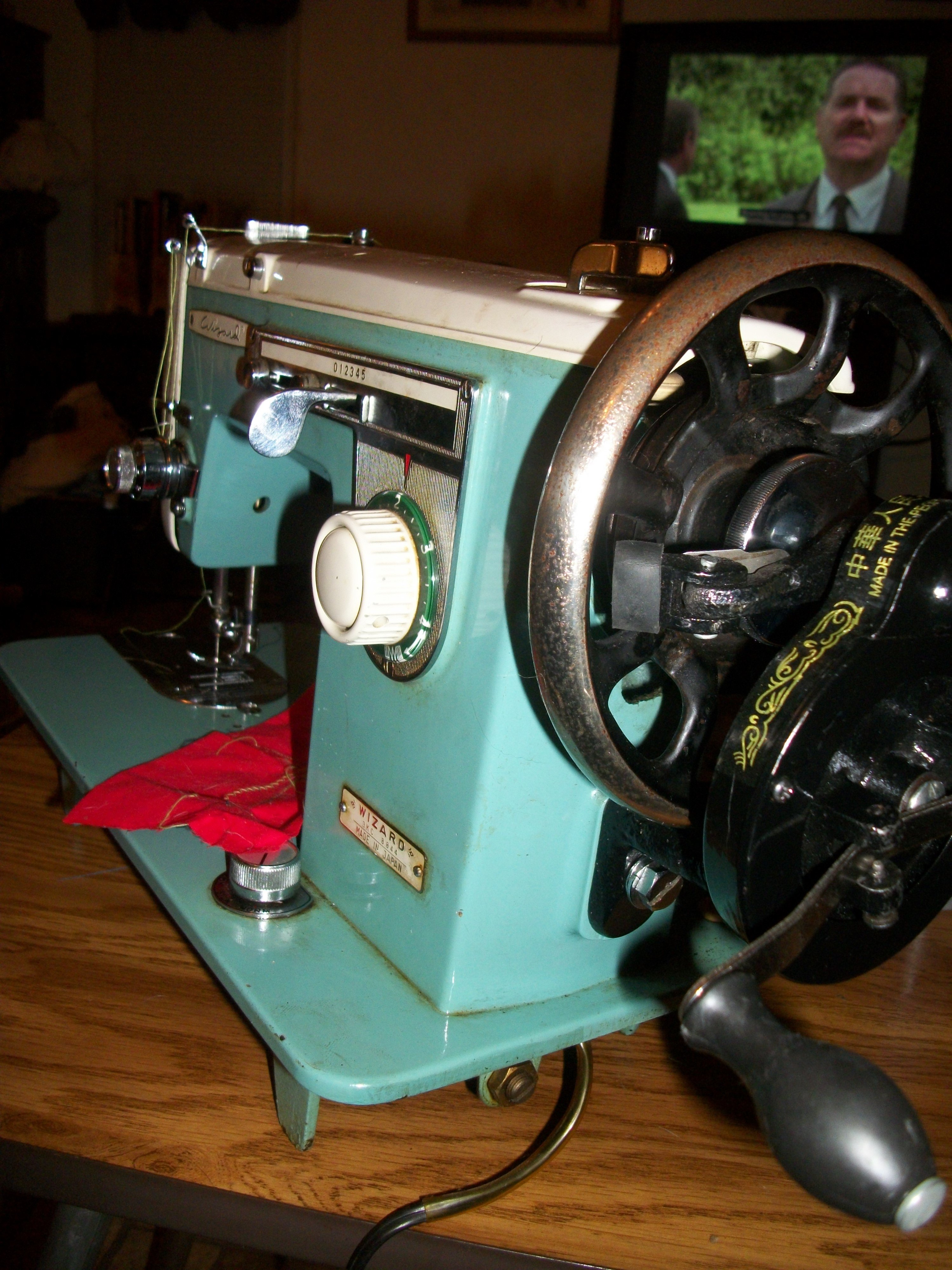
We got invited to a hot rod show so we took a cool looking Brother Wizard.  It turns out there was a pin up girl wearing the same colors as the machine.  The Brother was not designed to be a hand crank, but Leon was able to coax it into service.

This is a black slide vibrating shuttle  28 in a 3/4 cabinet.


This Bel Air is a Japanese Clone of a Singer 99


The Singer Spartan used the plastic case that this 99 is in.  We don't use this case for travel. The plastic in all of them is brittle and  brakes easily. This handcrank is  a modern reproduction from China.
We buy sewing machine oil by the gallon and pour it into bottles with extended spouts.  This machine can sew in reverse.  Most of ours don't.


Tuesday, July 31, 2018

Demonstrating at Living History Events

 One of the things we do as Merry Cranks is demonstrate the pennyfarthing bicycle and hand  crank sewing machines at living history events. We particularly enjoy demonstrating at events like Topeka's Apple Fest and the Cottonwood Falls' Flint Hills Folk Life Festival. When we are at events like this we get to have one on one visits with the festival goers and we let them try out our machines.


Kids really enjoy the pennyfarthing. They are far braver about getting on it to have their pictures taken than their parents are. We began demonstrating with the big penny. The one in the photos has a 48" wheel. Later we acquired a 38" pennyfarthing that fits the back of the car easier. It is also less intimidating for beginners.

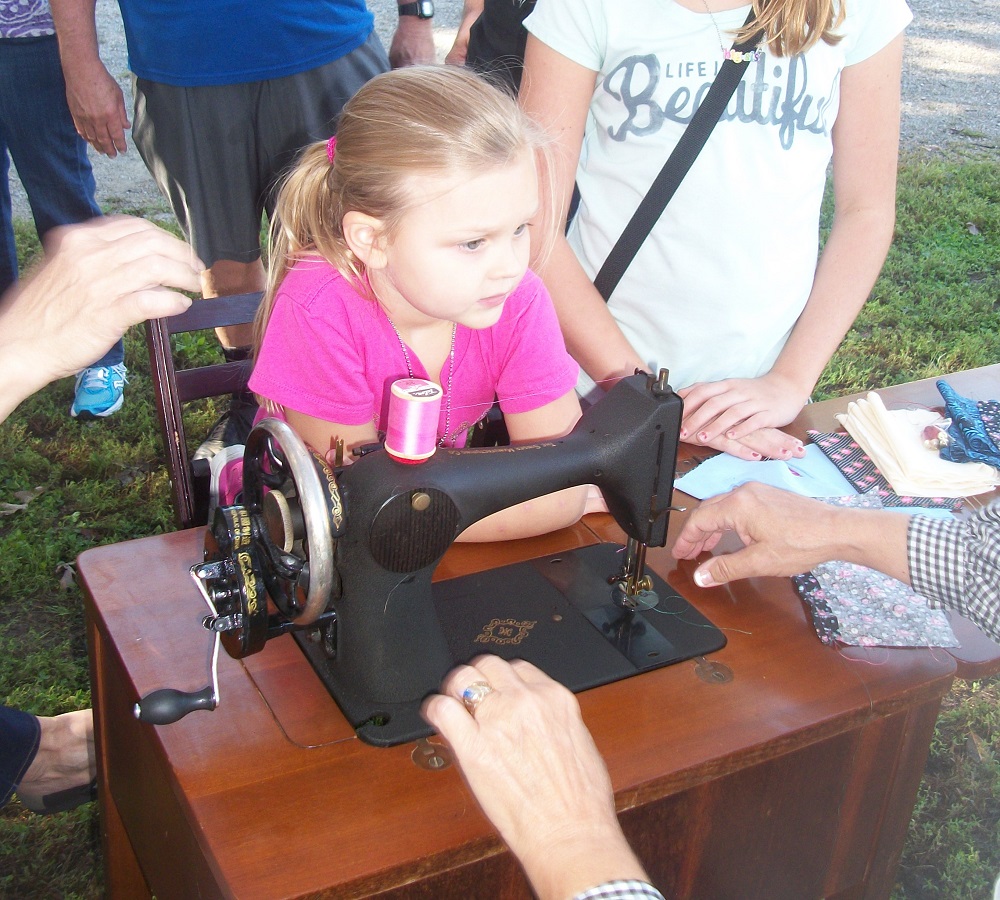
While Leon is showing off the high-wheeled bicycle, Iris demonstrates the sewing machine. Each person gets a rectangle of fabric and is taught to sew it into a Treasure Pocket. We have children who visit us every year to report that they have still got their Pockets.  The hand cranks are so easy to use, that many children tell their parents, "If I had one like this, I'd learn to sew!" 

Parents and grandparents also enjoy using the hand cranks. They often tell us about using a treadle that belonged to an older family member. Iris was amazed to hear about the home ec. class in the 1960s that was fully stocked with only treadle machines! Those girls must have felt like they were in a time warp.

Other exhibitors sometimes come by to play and we learn from them. Because we don't need electricity we can set up almost anywhere. One place was on a hill and that was really tricky though.


She is enjoying making a treasure pouch.


Saturday, December 16, 2017

Brother LS-2125i


Leon has been having fun servicing my daughter's Brother LS-2125i. It is one of the new machines we have dealt with. It was purchased about 1999-2000. The machine does a beautiful stitch but has not been used nor serviced for a good 10 years. Here you will see it "with the hood off."

Monday, March 27, 2017

Patty's Great-Grandmother's Davis Rotary

When Leon and I started collecting machines, I asked my brother if he might
have our Grandmother's old Singer. He said there was a treadle machine at his house but he didn't know anything about it. When we showed up to collect it, I realized it wasn't the Singer I expected, but one that had belonged to my late sister-in-law Patty. I called her sister Aleta to learn more.  Aleta was delighted to find it! The machine had belonged to their great-grandmother. She thought it had been lost.

Leon and I decided to restore the machine for Aleta. It would need the electric motor removed, the foot treadle replaced, a new belt, and a few other things. Leon immediately began cleaning and oiling it.

The machine is a Davis Rotary from about 1919. It came with bobbins, and a few odds and ends in the drawers. The manual was still there! (I immediately scanned it.) It was an expensive machine in its day. It has a chain lift that raises the machine when the lid is lifted. As the machine comes up, a panel folds back to allow room for the seamstress to put her feet on the treadle. Each drawer has a keyed lock and there is ornate scrollwork around the drawer pulls.

Learning to use the machine was a challenge. First, I discovered that it uses a needle called a Davis long that is no longer made. However, I was able to buy online an equivalent Boye needle that worked. Next was threading the machine. The tensioner didn't work like any of my Singers and the illustrations in the manual didn't quite match this model. I did a bunch of head scratching.  After a bit of trial and error, it would sew, but was the tension off! Together Leon and I struggled to get that set. 

Before we gave the machine to Aleta, we made four videos demonstrating the Davis. I will attach them as soon as I figure out how. :)

What do the Merry Cranks crank?

We are the Merry Cranks. We demonstrate  (foot cranked) bicycles, particularly the
replica pennyfarthing,  and hand crank sewing machines. We keep our eyes open for other low-tech materials that we might like to demonstrate. I found a popcorn popper at at  thrift shop the other day and Leon immediately went, "It's a hand crank!"

Our adventures began with bicycles. Leon is an avid collector of older bikes. Two of his prizes are the replica pennyfarthing and an 1890s lady's bike with wooden rims and wooden hand grips. We call her the Grand Dame. We enjoyed taking the pennyfarthing to living history events where children could see it, and maybe get their pictures taken sitting on it. Parents ask questions about why the bike had the big wheel and how it was used. Leon hasn't been stumped by a question yet!

Living history events mean period garb. That is no problem. I like to to sew. Sewing brought a maintenance problem. The Singer Featherweight I inherited from my Mom started skipping stitches.  I tried to fix it and made things worse. Leon...? He knew nothing about sewing machines, and he sure didn't want to ruin my mother's heirloom, but I persisted. He read the owner's manual and watched a few You Tube videos. VOILA! He fixed my machine and he was hooked. We started collecting older sewing machines as well as bicycles.

Our first "gig" demonstrating sewing machines was Earth Day at the Kansas History Museum.  My granddaughter was recruited to help us because we knew we would be demonstrating to kids in classroom quantities. We didn't realize 1600 students would visit that day! I had prepared 2000 pairs of fabric squares for the students to use as they sewed a seam on one of our three hand crank machines. When the day was done, only three scraps of fabric remained. Some students had visited more than once! 

We have the demonstrations down to a science now. You might find us at any event in eastern Kansas showing both sewing machines and bicycles. If it is a large venue, like the musuem, we still do small scraps of fabric. If we visit a more leisurely event we take 4x6" inch pieces of fabric that can be turned into Treasure Bags. We have seen repeat visitors who have confided to us that they still have their treasure bags. Keep an eye out. You might see us.